
 English
 русский
 Français
 Español
 Português
 Deutsch
 عربى

Forged Carbon Black Performance Metallic TPU Film draws inspiration from the raw, industrial beauty of forged carbon fibre and aerospace-grade black m...
See Details
Home / News / Industry News / Car Window Tint Film Explained: Types, Performance Specs, and Buying Tips
Car Window Tint Film Explained: Types, Performance Specs, and Buying Tips
Content
Most car window tint film buyers start with a shade, but the film type matters more than the shade. A dyed film and a nano-ceramic film can both be labeled 35% VLT, yet the ceramic film can reject about twice as much solar heat at the same darkness. That performance gap is why the first question should be about how the film is constructed, not just how dark it looks. This guide breaks down the main film categories, the specifications worth comparing, and the practical decisions that separate a good tint job from a costly mistake.
The Main Types of Car Window Tint Film
Five film constructions dominate the automotive aftermarket: dyed, metalized (or magnetron-sputtered), carbon, hybrid, and ceramic. Each has a different balance of cost, heat rejection, signal interference, and appearance. Knowing the construction explains the price spread you will see across film offerings from different manufacturers.
Dyed Window Film
Dyed film uses a polyester layer with an absorbing dye. It blocks visible light and reduces glare, but the dye absorbs heat instead of reflecting it, which means the glass can get quite hot. Dyed film is inexpensive and looks good when fresh, but it is more prone to fading and bubbling over time. It suits drivers on a tight budget who care more about privacy and looks than heat comfort.
Metalized and Magnetron-Sputtered Film
Metalized film uses a thin metal layer that reflects solar heat. Older metalized films were made by depositing metal in a way that could gradually oxidize, while modern magnetron-sputtered film is manufactured in a vacuum chamber, producing a denser, more uniform metal layer. The result is strong heat rejection with a slightly reflective appearance. The trade-off is that metal layers can interfere with GPS, radio, and toll transponder signals on some vehicles. If you are sourcing film for fleets or daily drivers that rely heavily on navigation, keep that in mind.
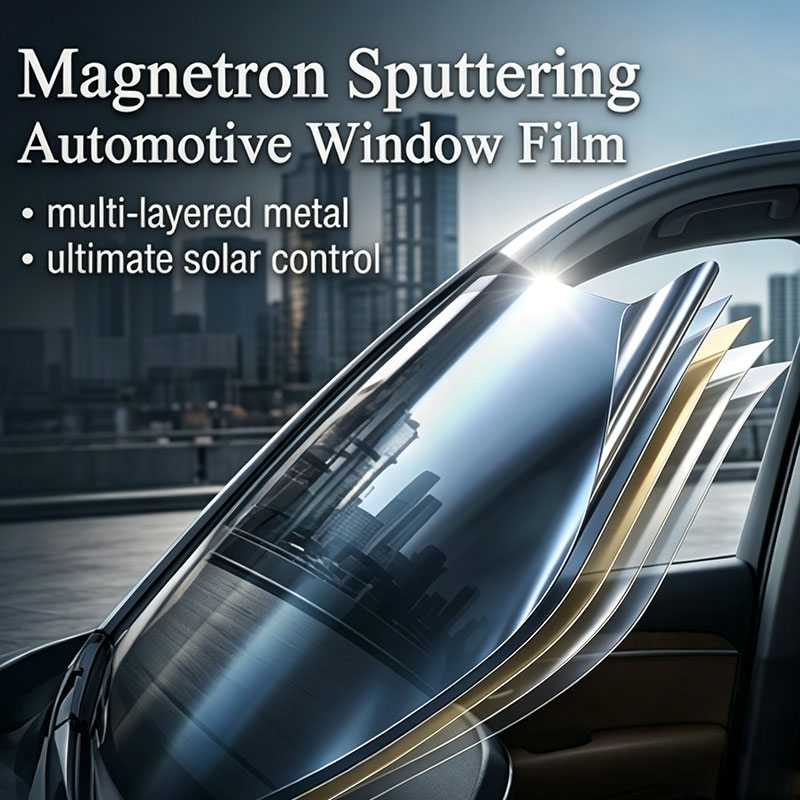 Premium Magnetron Sputtering Window Film with Dual Silver LayersThis film uses vacuum-deposited metal layers for strong heat rejection and low interior reflectivity, making it a top-tier choice for drivers who want performance without signal issues.View Product →
Carbon Window Film
Carbon film uses carbon particles embedded in the polyester layer. It provides decent heat absorption without the reflective look of metalized film, and it does not interfere with signals. The matte charcoal finish has its own aesthetic appeal. However, carbon film is generally a mid-tier option: better than dyed film, but not as effective at rejecting total solar energy as a good ceramic film.
Nano-Ceramic Window Film
Nano-ceramic film is the current premium standard. Ceramic particles are engineered at nanometer scale and embedded in the film, so the film blocks a wide range of solar wavelengths, including infrared and UV, without using metal. That gives ceramic film the best heat rejection-to-clarity ratio, no signal interference, and excellent fade resistance. The downside is cost: nano-ceramic film commands the highest price per square meter, and it rewards careful installation because the material is less forgiving of stretching errors.
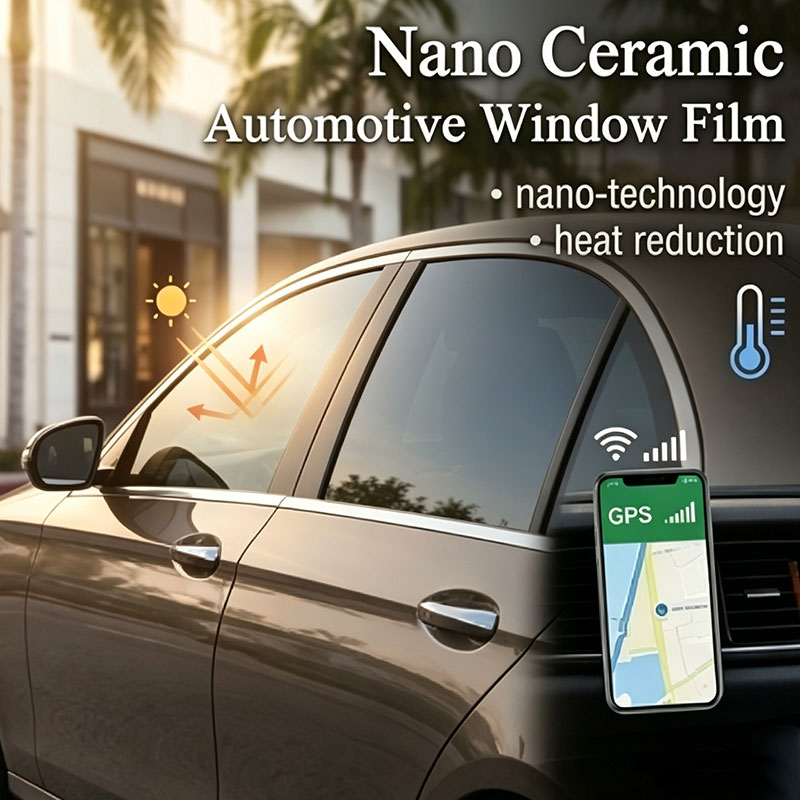 Nano Ceramic Window Film for True-Color Clarity and Heat RejectionEngineered with ceramic particles, this film blocks infrared and UV without metal, offering excellent clarity, no signal interference, and long-lasting fade resistance for daily driving.View Product →
Hybrid and Specialty Films
Hybrid film pairs a dyed layer with a thin metal layer, balancing cost and performance. There are also specialty films like iridescent or color-shift films, which alter the exterior look of the glass, and clear safety films that prioritize shatter resistance over shade. Each has a place, but for most passenger cars the choice comes down to dyed, metalized, carbon, or ceramic.
Performance Numbers That Actually Matter
Once you move past the film type, three numbers define how the film behaves on the car: VLT, UV rejection, and total solar energy rejected (TSER). A fourth, infrared rejection (IRR), is frequently quoted in marketing, but TSER gives a more complete picture because it combines visible light, infrared, and UV into one figure.
| Film Type | VLT Range | UV Rejection | TSER | Signal Interference | Relative Cost |
|---|---|---|---|---|---|
| Dyed | 5%–50% | ~95% | 25%–40% | No | $ |
| Metalized | 5%–50% | ~99% | 40%–55% | Possible | $$ |
| Carbon | 5%–50% | ~99% | 40%–50% | No | $$ |
| Nano-Ceramic | 15%–70% | >99% | 50%–65% | No | $$$ |
Visible light transmission (VLT) is the percentage of light allowed through the glass; a lower VLT means a darker tint. UV rejection should be at or above 99% on any film worth buying, because UV damage is the main culprit behind faded interiors and cracked dashboards. TSER is the number that tells you how much total solar energy the film keeps out of the cabin; the higher the TSER, the cooler the car stays in summer.
There is an important nuance: a film with high TSER does not necessarily look very dark. Nano-ceramic manufacturers, for example, can achieve high heat rejection while keeping VLT around 70%, which is why ceramic film is the typical recommendation for windshields in regions where dark front tint is illegal.
What Factory Quality Control Actually Changes
Film type and specs only tell part of the story; the manufacturing process decides how well those specs hold up over years of sun exposure and glass cleaning. Buyers who source directly from a factory should look for three things:
- Batch-to-batch consistency in coating density, adhesive thickness, and heat-shrink behavior.
- Peel strength on curved glass and defroster grids, where weak adhesive causes lifting.
- Abrasion resistance and haze stability, which decide whether a film still looks clear after years of cleaning.
Consistency matters most for shops that install film in volume. If roll tension, adhesive thickness, or coating density varies between batches, installers will notice the difference in cutting and shrinking behavior. A full-process manufacturer, one that controls coating, laminating, and slitting in-house, has a much easier time keeping those variables stable than a converter that buys film stock and only slits it to size.
Adhesive quality is the second thing to inspect. A film with good optics but weak adhesive will lift around defroster lines and curved glass edges. Factory quality checks should include peel strength testing and haze measurement on every production batch.
These are the areas where our quality control process focuses, because film failures on a customer's car damage both the installer's reputation and the factory's.
Matching Film to Window Position
The same film specification is not ideal for every window on a vehicle. The windshield, side windows, and rear glass face different solar angles and legal restrictions, and they serve different visibility needs.
For the windshield, the priority is high heat rejection with high VLT. Nano-ceramic film at 70%–80% VLT keeps the dashboard cooler and reduces glare while remaining legal in most jurisdictions. If you are stockpiling film for a full-car package, a light ceramic film for the windshield paired with a darker film for the rear sides is a widely used combination.
For side windows and the rear glass, the choice depends on local VLT law and the customer's privacy preference. Shops often carry one good ceramic film in multiple VLT values so they can meet both legal limits and customer taste without holding many different SKUs. On vehicles with rear defroster lines, the film's adhesive must bridge the heating grid without silvering, the cloudy spot that appears when adhesive does not fully wet out the lines, which is another reason to test film on actual rear glass before committing to a large order.
For customers who want to reduce glass shatter risk in addition to heat and privacy, a clear safety film on all side windows adds impact resistance with no visible change. This is a common upgrade on family cars and fleet vehicles.
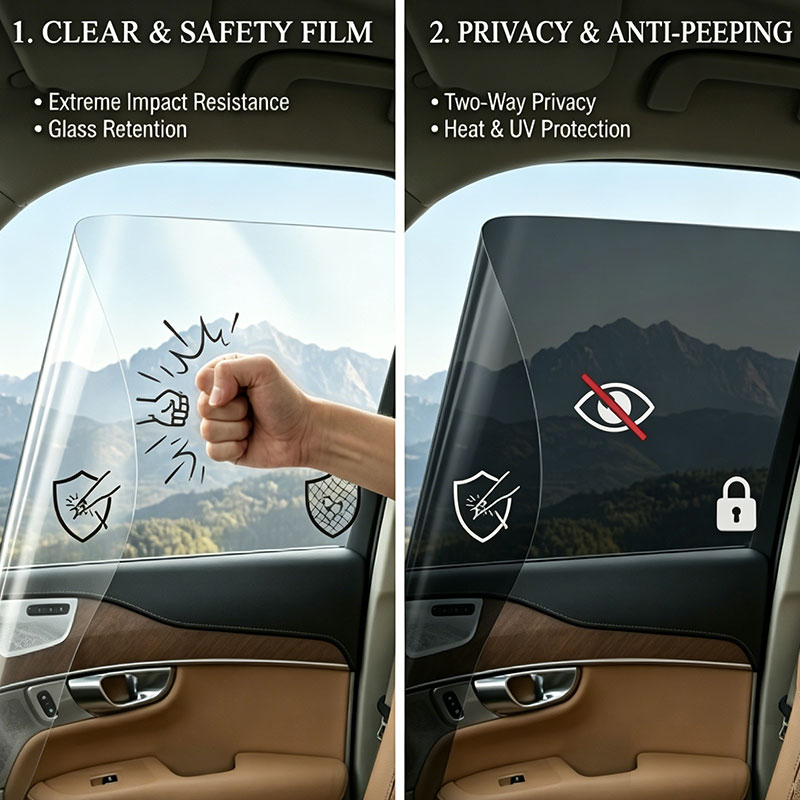 Clear Safety Window Film with Infrared Rejection for Shatter ProtectionThis hybrid film adds impact resistance to hold glass together while reducing solar heat, preserving high transparency for safe visibility and cooler cabins in family or fleet vehicles.View Product →
Legal Limits and Installation Realities
Before ordering large quantities, check the front-side and rear-window VLT limits for the market you serve. In the United States, limits vary by state; in Europe, many countries restrict front-side window tint to 30% VLT or stricter, with windshields often limited to a 70% VLT strip at the top. Supplying window tint film that is clearly outside local limits can create liability for the installing shop, so a responsible distributor keeps the legal map current.
Installation skill also affects film performance more than some buyers expect. Warping, creasing, or contamination under the film is visible immediately, but the bigger risk is improper shrink work on curved rear windows. A good rule is to order 10%–12% more film than the glass area calculation suggests, because shaping errors are normal even for experienced installers.
The practical way to choose car window tint film is to start with the window position, confirm the legal VLT limit, and then pick the best film construction your budget allows. Dyed film handles entry-level jobs, metalized and carbon films cover the mid-range, and nano-ceramic film delivers the best long-term performance. The specification sheet should show UV rejection above 99%, a TSER figure in the range you actually need, and no signal interference if the vehicle relies on GPS or toll systems. Distributors who want to discuss film supply, private labeling, or custom specifications can start with the factory's partner program. With those facts in hand, the purchase decision becomes a matter of price per square meter, not guesswork.
Related products
-
-
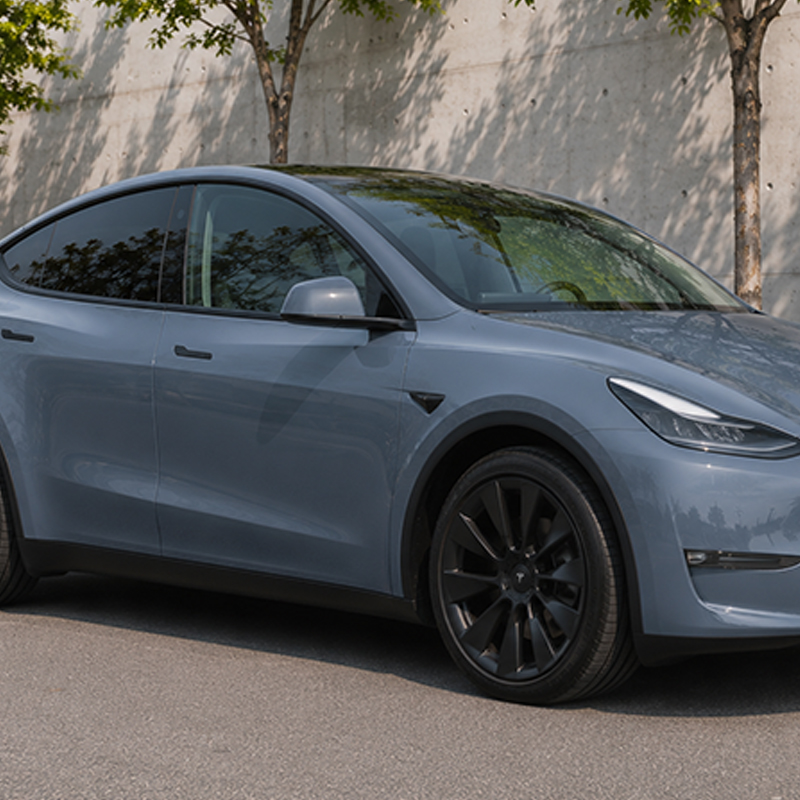
Kemora Grey Satin Crystal TPU Car Film offers a distinguished, European-inspired gray tone with a refined satin crystal finish that sits elegantly bet...
See Details -
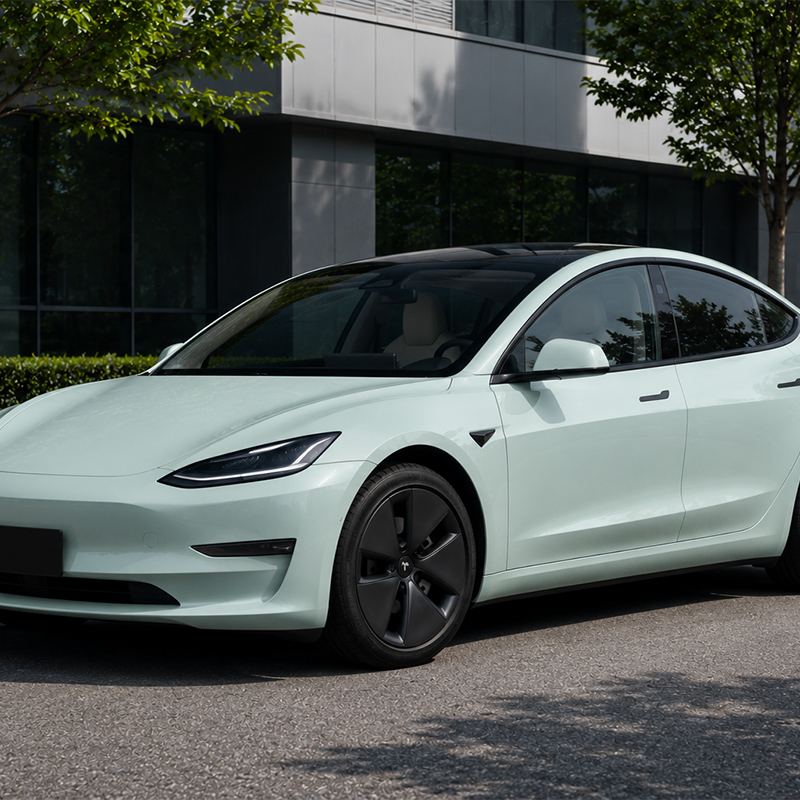
Somato Blue Liquid Pearl TPU Car Wrap Film presents a sophisticated, European-inspired deep blue in a liquid pearl finish that flows and shimmers with...
See Details -

Beetroot Purple is a rich, earthy, and deeply expressive color change PPF that channels the bold, organic depth of freshly cut beetroot into an unforg...
See Details
GET THE LATEST QUOTATIONS
-
 No. 5, Datang Road, East District, Development Zone, Guangde City, Xuancheng City, Anhui Province,242200, China
-
 [email protected]
-
 +86 18170340295
PRODUCTS
MOBILE WEB
Copyright Anhui He He New Materials Co., Ltd. All Rights Reserved.
 Wholesale TPU PPF Film Automotive TPU PPF Manufacturer