
 English
 русский
 Français
 Español
 Português
 Deutsch
 عربى

Advanced Solar Control & Safety for Modern Buildings Our architectural films are engineered using state-of-the-art Magnetron Sputtering Technology...
See Details
Home / News / Industry News / Window Film Tinted Glass: Key Specs, Shade Levels, and Buying Risks Explained
Window Film Tinted Glass: Key Specs, Shade Levels, and Buying Risks Explained
Content
A customer walks into a tint shop with a hatchback whose rear glass already carries a factory tint reading around 20% VLT. They want it darker. The installer who answers with "sure, we'll put 20% over it" is about to hand back a car with roughly 4% visible light transmission, effectively opaque at night and illegal in most markets.
That single multiplication explains most of what matters about window film on tinted glass. Tinted glass does not stop you from adding film; it changes which film you should buy. The short version: on glass that already carries colour, choose a clear, high heat rejection ceramic film instead of a dyed one, because VLT multiplies rather than adds. If you want the glass darker than the law allows, film is not the tool you need.
Everything below unpacks that rule, along with the numbers and the failure modes that actually decide whether the job holds up in year three.
Factory Tint and Window Film Are Two Different Products
Factory tint is not a film. On automotive glass it is usually a body tint: metallic oxides are added to the glass melt, so the colour runs through the entire pane. It never peels, bubbles or turns purple. Its limitation is that it is fixed at the moment of manufacturing, and it absorbs solar energy rather than reflecting it, which is why a dark factory-tinted pane can feel hotter to the touch than clear glass carrying a good film.
Aftermarket window film is a laminate. The typical build is a polyester base, a scratch-resistant hard coat, a metallised or ceramic functional layer, and a pressure-sensitive adhesive. It bonds to the interior surface of the glass. Colour comes from dyes, pigments or the interference effect of sputtered metal layers, and that distinction matters enormously when the glass underneath is already dark.
VLT Multiplies, It Does Not Add
Total visible light transmission through a filmed pane is the glass VLT multiplied by the film VLT. A 70% factory-tinted rear window with a 70% film lands at 49%. A 20% glass with an 80% film lands at 16%. Installers who add percentages instead of multiplying will quote a result that is wrong by a wide margin, and the customer only discovers it after dark.
The practical consequence is blunt. If your tinted glass already measures 35% VLT and your local limit for front side windows is 70%, no film on the market will bring you into compliance. Clear films top out somewhere around 90% VLT, and 35% multiplied by 90% is still only 32%. The glass itself has to change, and no product claim can rescue that specification.
The Five Specifications That Actually Decide the Result
Supplier datasheets are dense with numbers, and only a handful of them predict how a vehicle or a room will genuinely feel. Each figure below measures something different, and reading them correctly prevents most bad purchases.
| Specification | What It Measures | What to Look For |
|---|---|---|
| VLT | Visible light passing through the film alone | Multiply by glass VLT for the real figure |
| TSER | Total solar energy rejected across UV, visible and infrared | The most honest single heat figure |
| IR rejection | Infrared blocked, usually quoted at 900 to 1000 nm | Confirm the test band before trusting it |
| UV rejection | Blocking of ultraviolet between 300 and 380 nm | 99% is standard on quality film |
| Interior reflectance | Light bounced back into the cabin or the room | Above 20% causes night-time ghosting |
Two traps deserve emphasis. First, infrared rejection is the most heavily marketed number and the least comparable, because a film that blocks 99% at 950 nm may drop to 40% at 1500 nm. TSER integrates the whole solar spectrum and is the figure worth benchmarking. Second, on already-tinted glass the pane itself absorbs part of the solar load, so the whole-window TSER runs higher than the film's own rating. The extra heat is not being reflected away; it is travelling into the glass, which is precisely why dark factory glass gets so hot in direct sun.
Ceramic, Sputtered Metal and Dyed Film: When to Use Which
- Dyed film: the cheapest option and the shortest lived. Dyes fade under UV exposure and often shift purple within a few years. Stacking a fading dye layer onto tinted glass compounds the problem.
- Sputtered metal film: strong heat performance and a clean reflective look, but the metal layer can interfere with GPS, mobile reception and electronic toll tags depending on the vehicle.
- Nano-ceramic film: infrared-absorbing particles replace the metal, so there is no signal interference and VLT can stay high. This is the logical choice when the glass is already coloured and the goal is heat rejection rather than extra darkness.
For a factory-tinted car where heat is the complaint rather than shade, a nano-ceramic film adds rejection without pushing visible transmission any lower than the glass already does.
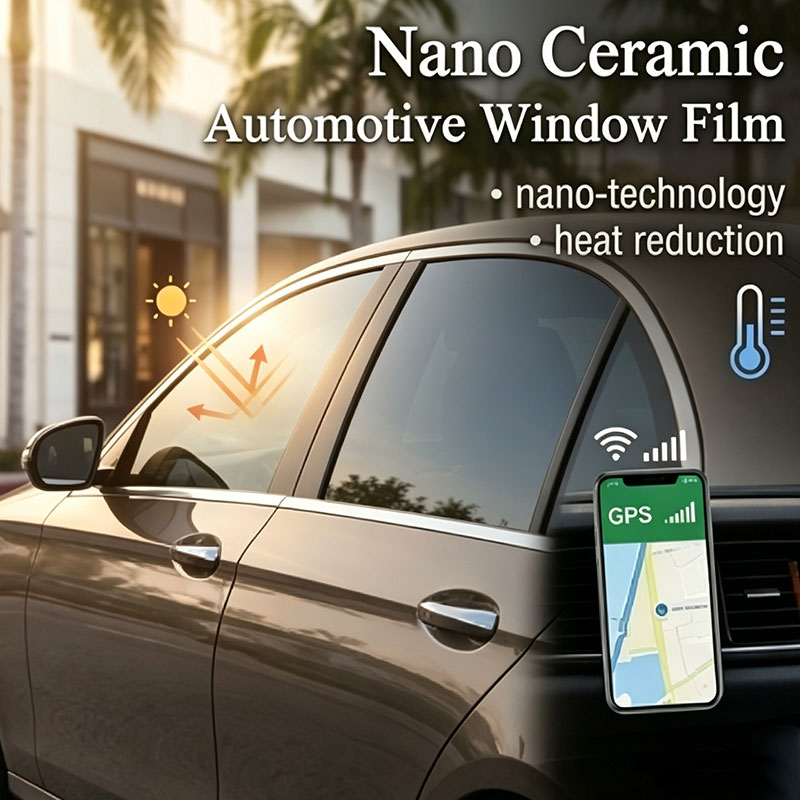 Nano Ceramic Automotive Window FilmNatural-tone nano-ceramic film designed for true-color clarity.Hybrid original-color and nano-ceramic technology with superior UV protection, highheat rejection, and a...View Product →
Safety Film, Adhesive Quality and Signal Problems
On glass that is already dark, the layer that matters most is the one nobody inspects: the adhesive and the hard coat. A cheap film with a weak adhesive fails at the edges first, and on a tinted pane that failure is harder to disguise because the lifting film shows as a pale grey line against darker glass. Adhesive systems vary widely in expected service life, and the supplier should state the figure rather than leave it to interpretation.
When the goal is break-in resistance rather than heat rejection, a clear safety film is the correct purchase. It is essentially colourless, so it layers onto tinted glass without meaningfully changing the combined VLT, and its function is to hold the pane together after impact. Reference standards differ by market, with automotive glazing specifications such as ANSI Z26.1 among the usual benchmarks, and a competent supplier will say which one applies rather than implying compliance in general terms.
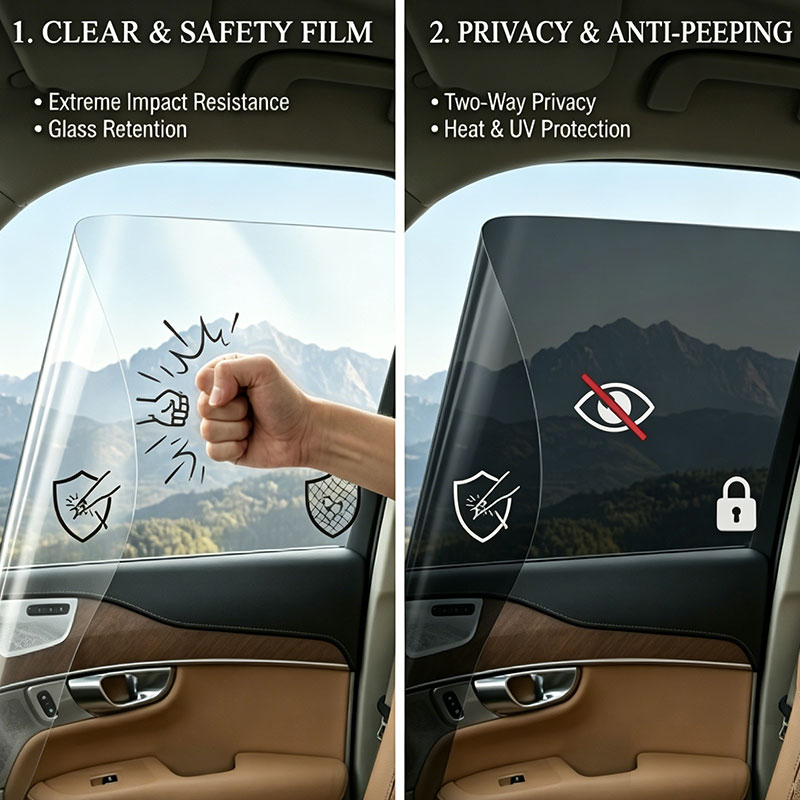 Clear & Safety Automotive Window FilmA high-performance hybrid film designed for maximum safety and transparency. It features an extra-strength safety layer to prevent glass shattering upon impact, combin...View Product →
Is Adding Film to Tinted Glass Legal?
Rules differ by country and frequently by state or province, and they almost always describe a minimum visible light transmission for named windows rather than referring to films at all. Three patterns recur across most markets:
- Front side windows and windshields are held to a higher VLT than rear glazing, commonly 70% in many jurisdictions, though this varies considerably.
- Factory tint counts as part of the glass, so it counts toward the limit. A vehicle that passed inspection with dark factory rear glass can still fail once film is added on top.
- Enforcement is typically a handheld meter at the roadside, and that meter reads the combined glass-and-film figure, not the film alone.
The takeaway for a buyer is straightforward: measure the glass before ordering anything. An inexpensive transmission meter reading taken before purchase prevents the most common and most expensive mistake in this category, which is paying twice because the first film had to be stripped a month later.
Architectural Glass Runs on a Different Calculation
Building film meets a different set of constraints, and the biggest one is not visible transmission. It is thermal stress. On a tinted or coated architectural pane, especially inside an insulating glass unit, film changes how the glass absorbs and re-radiates heat. Uneven absorption between filmed and unfilmed areas of the same pane can generate enough differential stress to crack the glass or void the unit's warranty.
- Single-pane clear glass is the lowest-risk substrate for almost any film.
- Double-pane and laminated assemblies require a film rated for that substrate, and the manufacturer should state it explicitly rather than implying it.
- Body-tinted and highly absorbent glazing is the highest-risk category and often needs an exterior film or no film at all.
- Low-E coatings must be identified before any quotation, because the coating position inside the assembly changes the whole thermal calculation.
Specifiers who want the underlying numbers, including emissivity, shading coefficient and how each interacts with existing glazing, will find a closer look at architectural window film performance metrics useful before committing to a purchase order.
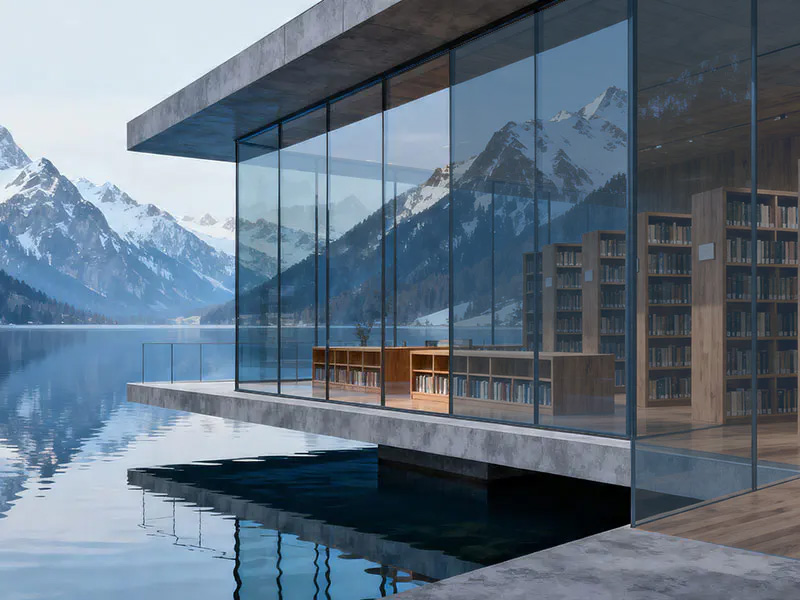 Architectural Window FilmAdvanced Solar Control Safety for Modern BuildingsView Product →
How to Buy Without Repeating the Job
For anyone purchasing window film at volume, whether a tint shop, a fleet operator or a facilities manager, the questions that separate dependable suppliers from the rest are mundane and specific:
- Can you provide a test report for this exact SKU rather than for the product family?
- What is the VLT tolerance across a production roll, expressed in percentage points?
- Which glazing standards does this film carry, and are those reference numbers printed on the liner?
- What adhesive system is used, and what service life is expected on an interior glass surface?
- Is the film coated in your own plant, or sourced from a third party?
That final question sorts the field quickly. Manufacturers running their own coating lines can answer the first four with data, because they control the process that produces the tolerance figures, the adhesive formulation and the test reports in the first place. Traders generally cannot, and their answers tend to be vague in exactly the places where precision matters most. Checking a supplier's quality control documentation before placing a first order is a faster filter than comparing catalogue prices.
None of this is complicated once the multiplication rule is in place. Measure the glass, multiply by the film you are considering, compare the result against the local limit, then choose the film that adds the performance you are missing rather than the colour you already have. On tinted glass, the film's job is almost always to reject heat, hold the pane together and stay optically clear for a decade, not to make the window darker than it already is.
Related products
-

-
Lolita Pink Candy Crystal TPU Wrap Film is a celebration of sweetness, femininity, and playful luxury. Inspired by the delicate, candy-like aesthetics...
See Details -
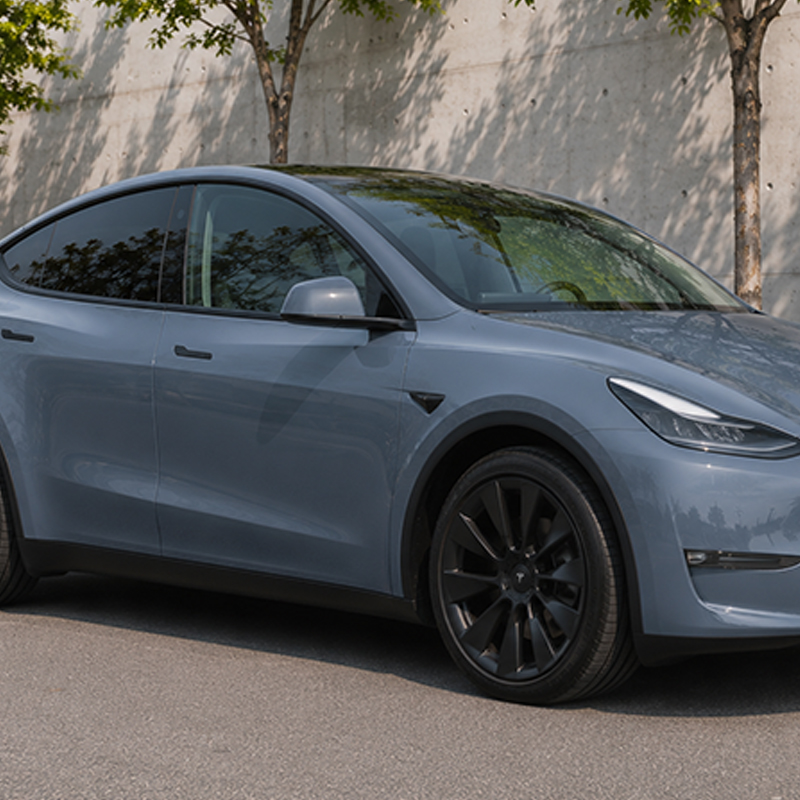
Kemora Grey Satin Crystal TPU Car Film offers a distinguished, European-inspired gray tone with a refined satin crystal finish that sits elegantly bet...
See Details -
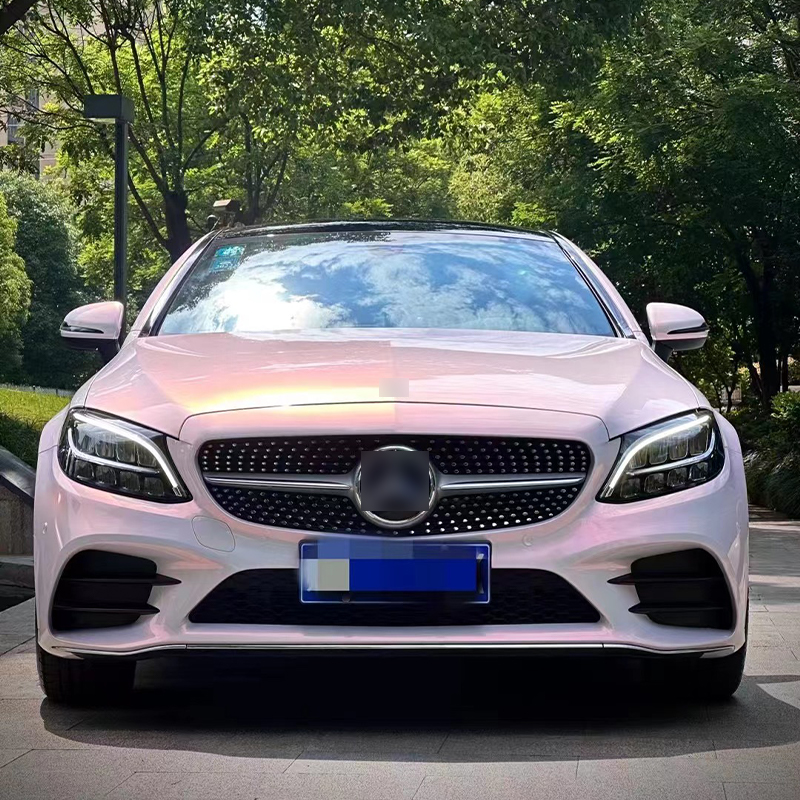
Dreamy Volcanic Ash is a dual-color chameleon TPU paint protection film offering a poetic, otherworldly color palette inspired by the soft grey-purple...
See Details
GET THE LATEST QUOTATIONS
-
 No. 5, Datang Road, East District, Development Zone, Guangde City, Xuancheng City, Anhui Province,242200, China
-
 [email protected]
-
 +86 18170340295
PRODUCTS
MOBILE WEB
Copyright Anhui He He New Materials Co., Ltd. All Rights Reserved.
 Wholesale TPU PPF Film Automotive TPU PPF Manufacturer